November 2025
AI in Healthcare: Why the boring stuff is the most exciting (for now)
AI is reshaping industry everywhere. In healthcare, many headlines have focused on potential clinical advances of AI, but Madryn believes the first wave of meaningful impact is materializing not in the clinic, but in the back office.
Madryn believes that administrative functions have emerged as the most practical and immediate starting point for the adoption of generative AI in healthcare, offering a faster, lower-risk, and more economically efficient path to value creation. Importantly, administrative AI benefits from fewer regulatory barriers when compared to high-profile clinical applications, such as AI-assisted imaging or drug discovery.
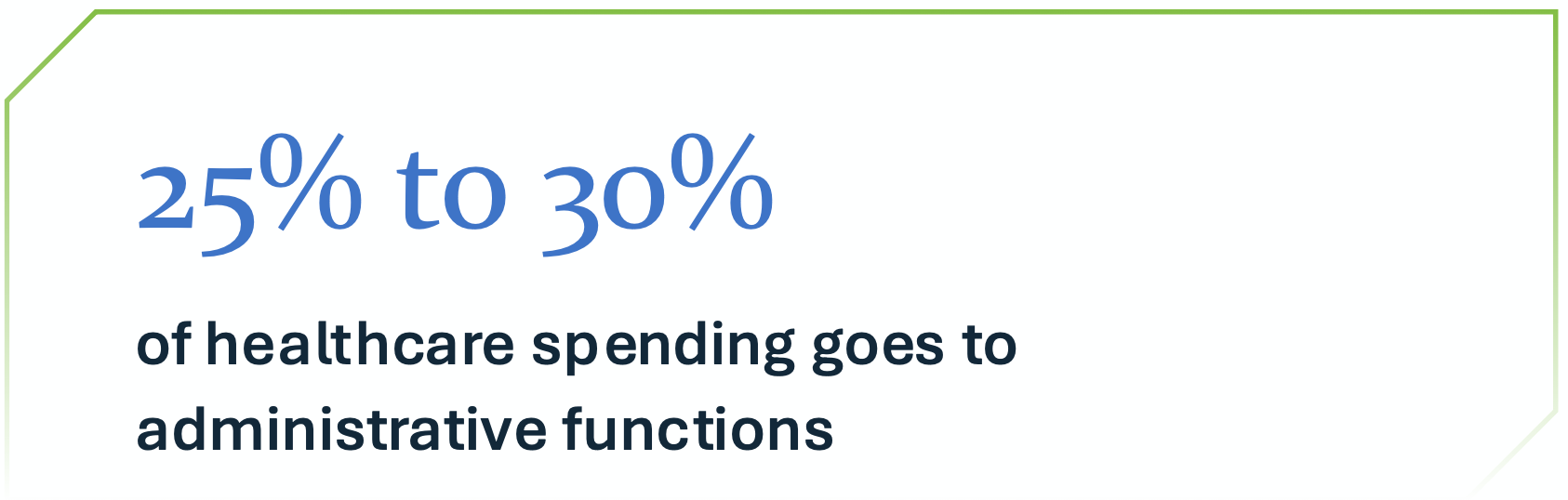
The healthcare industry, a $4.9 trillion market representing nearly 18% of U.S. GDP,1 is ripe for disruption and efficiency gains. An estimated 15 to 20 cents of every healthcare dollar is spent on transaction costs tied to administrative processes. In total, roughly 25% to 30% of total healthcare spending — over $1 trillion annually — is consumed by administrative functions.2 Healthcare organizations face significant documentation requirements, creating a clear opportunity for AI solutions that minimize provider administration, streamline repetitive tasks, and facilitate patient engagement.
The U.S. market for healthcare AI is projected to grow at a CAGR of 36.1% between 2024 and 2030, expanding from ~$11.8 billion in 2024 to approximately ~$102 billion by 2030.3 In this paper, we outline some of the opportunities we are seeing for AI in the healthcare industry and what investors should look for.
Providers as early adopters of AI
The healthcare ecosystem consists of three major constituents: the providers delivering medical services, the payers financing those services, and the life sciences companies producing drugs, medical devices, and related technologies. Of those, providers and payers execute millions of data-intensive administrative workflows daily. Staffing shortages and regulatory complexity have increased the pressure on these high-volume processes. AI large language models (LLMs) are well-suited to automate these processes, reducing administrative cost and burden.
Providers, in particular, face significant challenges. Rising claim denials, shrinking margins, and the growing share of financial responsibility borne by patients have made operational efficiency critical. Despite the promise of electronic health records (EHRs), providers in outpatient settings spend nearly six hours on EHRs for every eight hours of patient care,4 which contributes to, rather than reduces, physician burnout. Providers are devoting hours completing patient charts, requesting prior authorizations, following up on tests, logging results, and completing tasks in the EHR. AI-based applications can help recapture the ~40% of clinician time spent on these administrative tasks.
AI delivers value in provider administration
AI integration in administrative workflows is already proving its value to providers by streamlining revenue cycle management (RCM), strengthening patient engagement, and improving operating capabilities. To date, we have seen providers adopt AI to support several high-impact use cases:
- Patient access and scheduling: Optimizing appointments and intake workflows through virtual assistants
- Prior authorization acceleration: Predicting payer requirements and auto-generating justifications using AI models
- Clinical documentation support: Employing AI-assisted scribing tools to decrease clinician burden and improve data quality
- Claims and coding automation: Reducing manual effort in revenue cycle management through natural language processing and machine learning
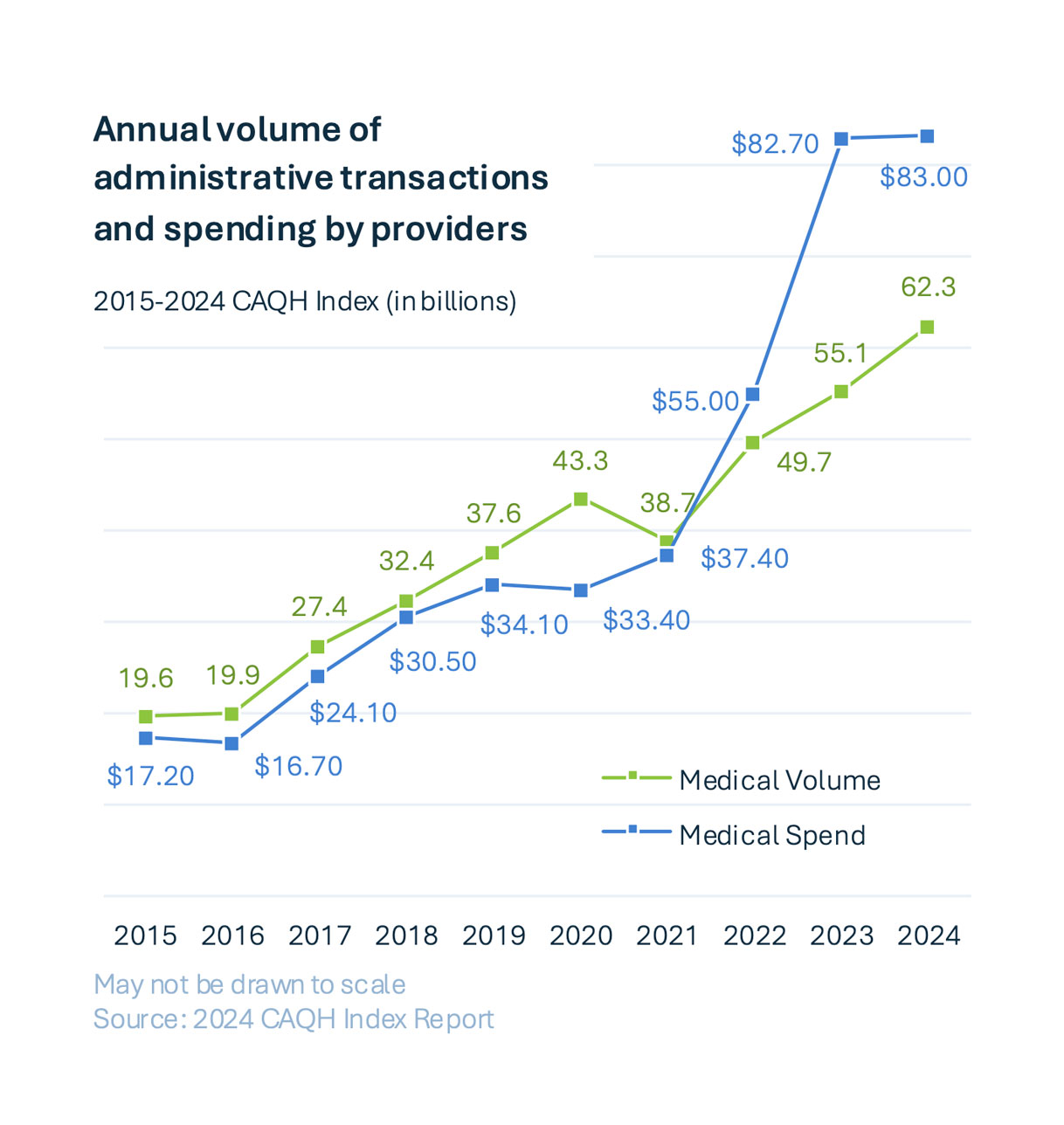
Adoption is growing, with AI usage by physicians jumping from 38% in 2023 to 66% in 2024.5 The most common applications for this early adoption are documentation of billing codes, updating of medical charts, and scribing of visit notes.
Streamlining scribing as part of RCM
Abridge records real-time conversations between doctors and patients during visits and produces after-visit summaries using an LLM. Adopted by dozens of major health systems, the company supports more than 100,000 clinicians in improving clinician experience, patient experience, and outcomes, with 77% of clinicians reporting Abridge improved patient engagement by decreasing documentation burden and 73% reporting decreased time spent documenting outside of clinical hours.
Healthcare providers as potential AI investment opportunities
AI-driven investment opportunities extend beyond companies that build AI. We believe established healthcare providers that effectively integrate AI into their operations also offer the potential for value creation. Providers and payers both face distinct administrative burdens, incentives, and constraints, many of which could benefit from AI adoption to drive efficiency and scale. For investors, the critical lens should be how effectively AI is integrated within the organization.
Much of today’s investor focus in AI is on venture-backed startups. These are companies that are developing proprietary algorithms or niche tools to target workflows that range from prior authorization to appeals automation. However, we believe midsize to large established healthcare companies offer the opportunity to generate significant value through internal AI implementation in existing, regular-way processes.
The path from administrative to clinical AI
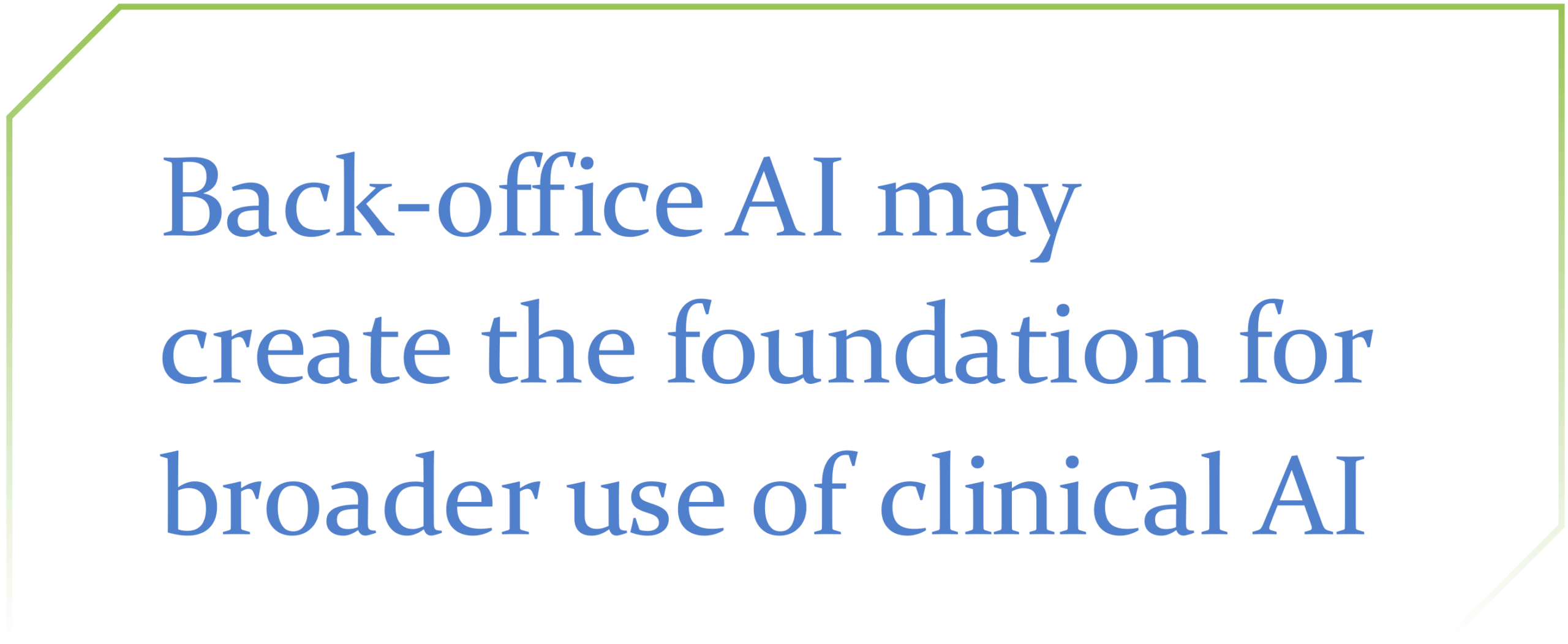
Madryn is also watching as administrative AI helps clear a path for successful implementation of AI in clinical applications. As stakeholder trust builds and results materialize, administrative functions may integrate more advanced AI healthcare capabilities. The infrastructure and data pipelines built through back-office AI form the foundation for more advanced, patient-facing clinical use cases. We believe healthcare companies that demonstrate results with administrative AI solutions may expand into adjacencies, bridge into clinical workflows, and, in some cases, move into AI-driven drug discovery.
As noted, administrative AI faces lower levels of regulatory risk, whereas clinical AI faces a steeper path to commercialization. Tools that aim to improve diagnostic uncertainty, generate treatment plans, or manage drug interactions must demonstrate improved outcomes and clear regulatory pathways before broad industry adoption. Besides meeting rigorous validation standards, they must also overcome additional hurdles, including patient safety concerns, evolving regulatory frameworks, and complex ethical and legal considerations. Despite these obstacles, AI solutions continue to be developed across a broad range of clinical applications.
The lower regulatory bar and more rapid adoption of administrative AI suggests that companies offering hybrid solutions that span administrative and clinical AI capabilities are best positioned to become long-term platform leaders. Early success in non-clinical areas allows these companies to refine their technical capabilities, establish credibility, prove ROI, and earn organizational buy-in before expanding into more regulated domains.
Path AI: An early example of bridging from administrative to clinical AI
PathAI was founded in 2016 as a technology solution to provide structured reporting and workflow optimization for pathology labs. Demonstrated success in reducing pathology error rates led to expansion into AI-powered clinical diagnostics, including tumor detection, biomarker quantification, and drug development partnerships.
Focus on implementation is required to deliver a return on AI investment
Regardless of the technical advantages offered by AI focused on administration, the benefits cannot be realized without effective implementation, committed oversight, and strong change management capabilities. Madryn’s experience with growing healthcare businesses suggests that investors consider the following factors when evaluating a potential opportunity:
Endnotes
1 U.S. Department of Health and Human Services: National Health Expenditure Accounts: Methodology Paper, 2023
2 McKinsey & Company, Administrative simplification: How to save a quarter -trillion dollars in US healthcare, 2021
3 Grandview Research, U.S. Ai In Healthcare Market Size & Outlook, 2023-2030, 2025
4 American Medical Association, Five physician specialties that spend the most time in the EHR, 2024
5 American Medical Association, 2 in 3 physicians are using health AI—up 78% from 2023, 2025
6 JAMA Network Open, Use of Ambient AI Scribes to Reduce Administrative Burden and Professional Burnout, 10/2/2025
7 Mckinsey & Co., McKinsey Healthcare Blog: Principles for provider investments in 2025, 10/14/24.
Disclaimers
This content is provided for informational and educational purposes only, and reflects the views and opinions of Madryn Asset Management, LP and its affiliates (“Madryn”) as of the date indicated. Such views and opinions are subject to change without notice, and Madryn undertakes no obligation to update or revise any information herein. The information contained herein does not constitute, and should not be construed as, an offer to sell or a solicitation of an offer to buy any security or investment product, or as the provision of investment advice or an offer of advisory services by Madryn. Certain information contained herein has been obtained from third-party sources that Madryn believes to be reliable; however, Madryn makes no representation as to the accuracy, completeness, or timeliness of such information and has not independently verified it. Past performance or trends described herein are not indicative of future results, and any forward-looking statements involve significant risks and uncertainties. Actual outcomes may differ materially from those expressed or implied, and Madryn undertakes no obligation to update or revise such statements. Madryn has no direct financial interest or conflict of interest with respect to any specific companies referenced herein. This paper may not be reproduced, distributed, or published, in whole or in part, without the prior written consent of Madryn.
MADRYN ASSET MANAGEMENT
+1 (646) 560 5490 | IR@madrynlp.com
330 Madison Ave, 33rd Floor
New York, NY 10017